Techniques and materials
We build using several techniques, from traditional Canadian round logs to glulam beams. Each has its own look, its own building rhythm and a different settling period. We’ll help you choose the right one, and the timber your house will be made from.
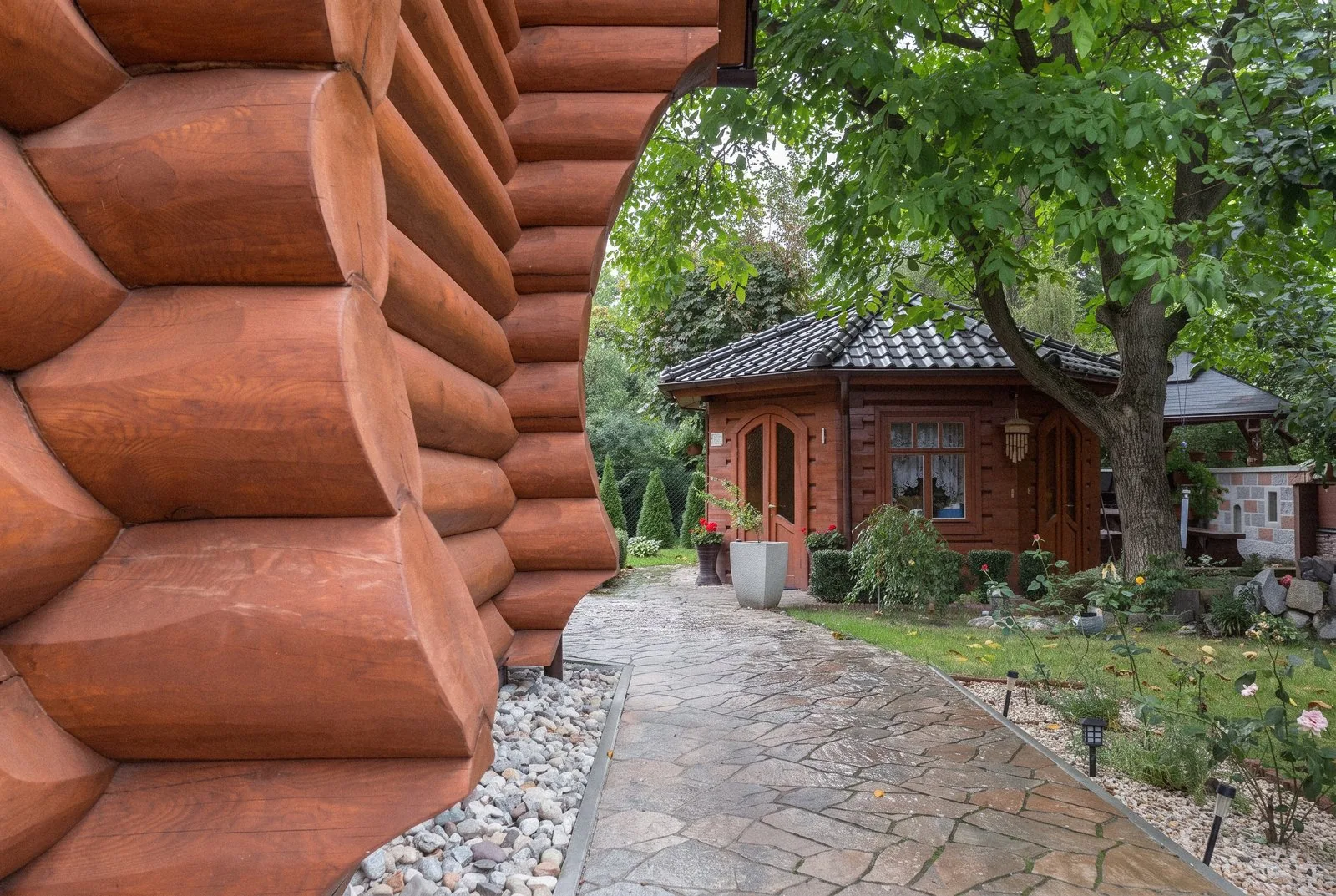
Five ways to build a log house
Traditional methods proven over centuries, backed by what we know today about how timber behaves and how to protect it. Pick a technique to see how they differ.
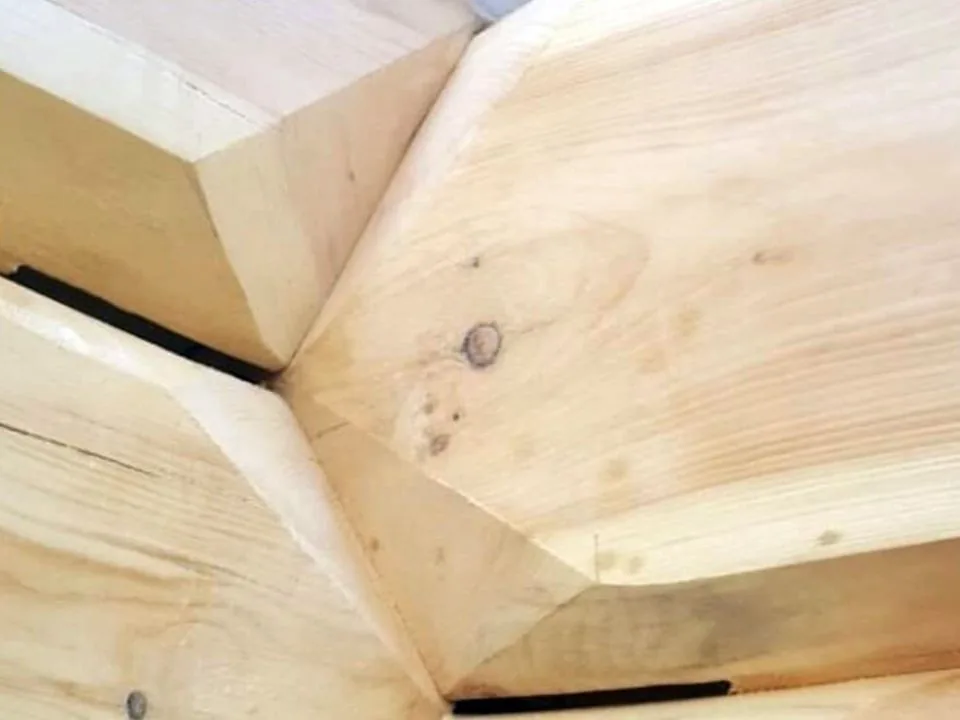
Norwegian technique
The building element is the two-sided log, a log sawn flat on two sides. The walls are straight inside and out, with naturally rounded corners. Hand-cut with an axe, the Norwegian joint locks tighter under the house’s own weight as it settles, wedge into wedge, which stops the walls from deforming or twisting.
- The two-sided logs are pinned vertically with wooden dowels made from the same timber as the rest of the house, so the walls stay straight.
- Assembly is followed by the settling period, and only then are the openings measured for made-to-measure windows and doors.
- With its straight walls, it looks closer to a conventional building, so a Norwegian log house fits more easily into the local landscape character. It’s one of our clients’ favourites.
- Typical timber
- pine, larch
- Log diameter
- 280-500 mm
- Two-sided log thickness
- 200 mm, 150 mm for small buildings
- Settling
- 30-50 mm
- Seasoning time
- 7-8 months
Canadian technique
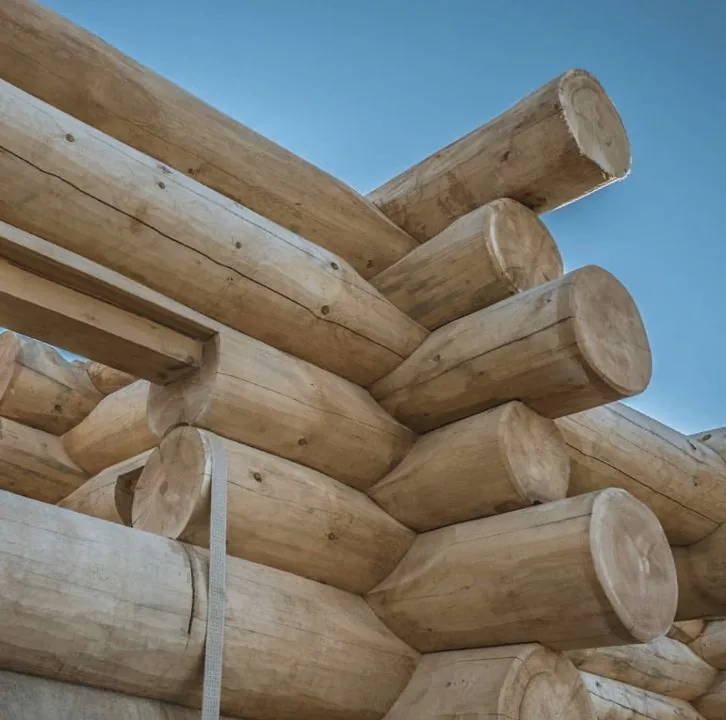
The main element is the round log: a trunk that’s simply been stripped of its bark. The logs sit tight against one another with no gaps, so the walls read as one solid mass, and they keep their natural curves, which give every house its own character. The corner joints, shaped to the millimetre, are the pinnacle of the carpenter’s craft.
- We keep the firm outer layer of the log, roughly 3-5 cm thick, which stops the walls freezing through and makes them more resistant to mould, blue stain and UV.
- Self-locking joint: as the logs settle, they close up the gaps in the groove and the saddle notch, so the joints don’t need sealing afterwards.
- You can choose the classic version or the Brilliant variant, which differs in the way the overhangs and the bottom notch are cut.
- Typical timber
- pine, larch
- Log diameter
- 280-500 mm
- Settling
- 70-100 mm
- Seasoning time
- 12-18 months
Hook-notch technique
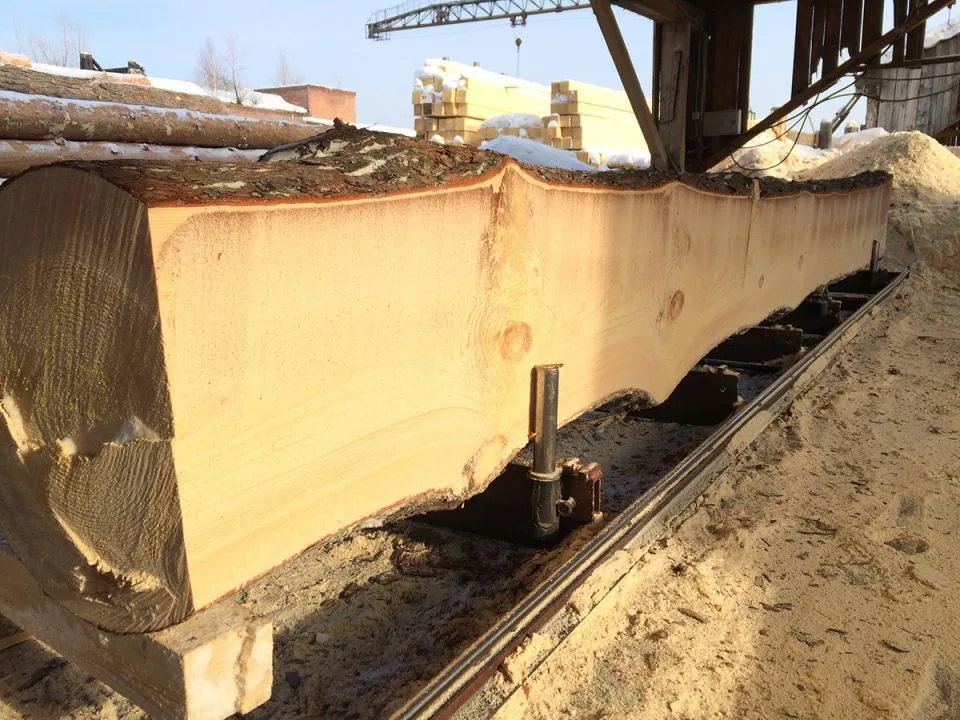
The logs are naturally round on the outside, hewn flat on the inside and round again at the corners. The technique comes from the old carpenters of the Nizhny Novgorod region, famous for hand-built log houses and wooden boats. It takes real carpentry skill, and its corner joint is one of the most reliable there is.
- The beauty of round logs outside, with straight, practical walls inside.
- The planed walls need no further finishing, which brings a noticeable cost saving.
- Corner joint with projecting log ends and a main tenon.
- Typical timber
- pine, larch
- Log diameter
- 280-500 mm
- Settling
- 60-90 mm
- Seasoning time
- 10-14 months
Glulam beams
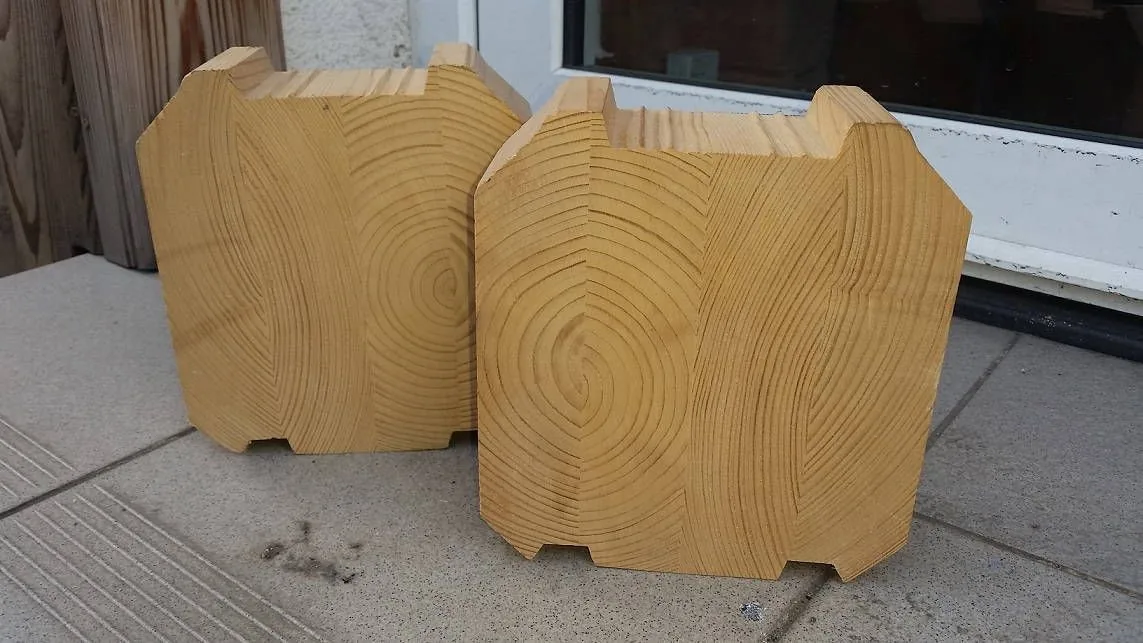
This modular technique is built around glulam beams made from fir lamellas, bonded with eco-friendly adhesive by Casco Adhesives, part of the Swedish group AkzoNobel. Its big advantage is that there’s no settling period, so you can move in almost as soon as the house is finished.
- We make the beams in three profiles: 212 × 186, 169 × 186 and 126 × 186 mm.
- Assembly is much quicker: around 3.5 m³ per shift, against 1.5 m³ with the Canadian technique.
- Four people can put up a 200 m² house in 20 days.
- Material
- fir lamellas
- Beam profiles
- 212, 169 and 126 × 186 mm
- Assembly speed
- approx. 3.5 m³ per shift
- Settling period
- not needed
Japanese load-bearing frame
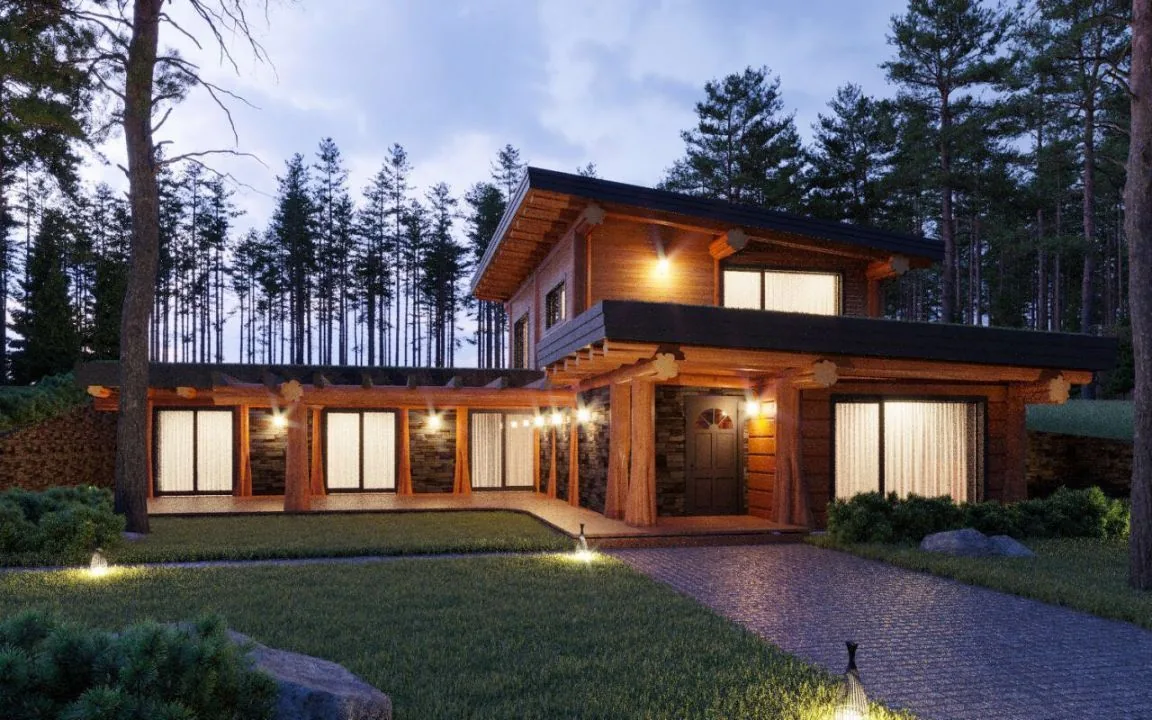
This old Japanese technique, also known as post & beam, is built on a frame of posts that carry the structure, the roof and the system of beams. The frame is held firmly together by an ingenious system of cramps and bolts, which makes it exceptionally robust. Settling stays within 1-2%.
- Combined with moon wood, it needs no settling period: once in place, the trunks and beams don’t move by so much as a millimetre.
- We worked on a family log house in Siberian cedar in Městečko using this technique.
- Structure
- frame of posts and beams
- Joints
- cramps and bolts
- Settling
- 1-2 %
- Settling period
- not needed with moon wood
The techniques compared
The main differences at a glance. We’ll gladly talk through which technique suits your plot and the way you live.
| Parameter | Norwegian | Canadian | Hook-notch | Glulam beams |
|---|---|---|---|---|
| Building element | two-sided log, sawn flat on two sides | debarked round log | log rounded outside, hewn flat inside | glulam beam made from lamellas |
| Walls outside / inside | straight / straight | round / round | round / straight | straight / straight |
| Element size | logs 280-500 mm, two-sided log 200 mm | logs 280-500 mm | logs 280-500 mm | 212, 169 and 126 × 186 mm |
| Typical timber | pine, larch | pine, larch | pine, larch | fir |
| Settling | 30-50 mm | 70-100 mm | 60-90 mm | no settling period |
| Settling period | 7-8 months | 12-18 months | 10-14 months | not needed |
The timber we build with
Long, freezing winters and short summers give Siberian species tight growth rings, which make the wood strong, high in quality and durable.
Siberian larch
Up to twice as resistant to rot as oak, ash or pine. It’s hard, has few knots and is as strong as oak; larch piles have held up Venice for hundreds of years. It also contains phytoncides, which help you relax.
Angara pine
One of the densest pines there is. The tree grows for 150 to 200 years and reaches up to 50 metres. The wood doesn’t crack as it dries, has low thermal conductivity, and its essential oils give it a delicate scent and an antimicrobial effect.
Siberian cedar (stone pine)
The diamond of timbers. It insulates against heat loss and noise better than other species, smells of the taiga and has an antiseptic effect. A 24-25 cm wall is equivalent to a spruce wall 45-50 cm thick.
Winter-felled moon wood
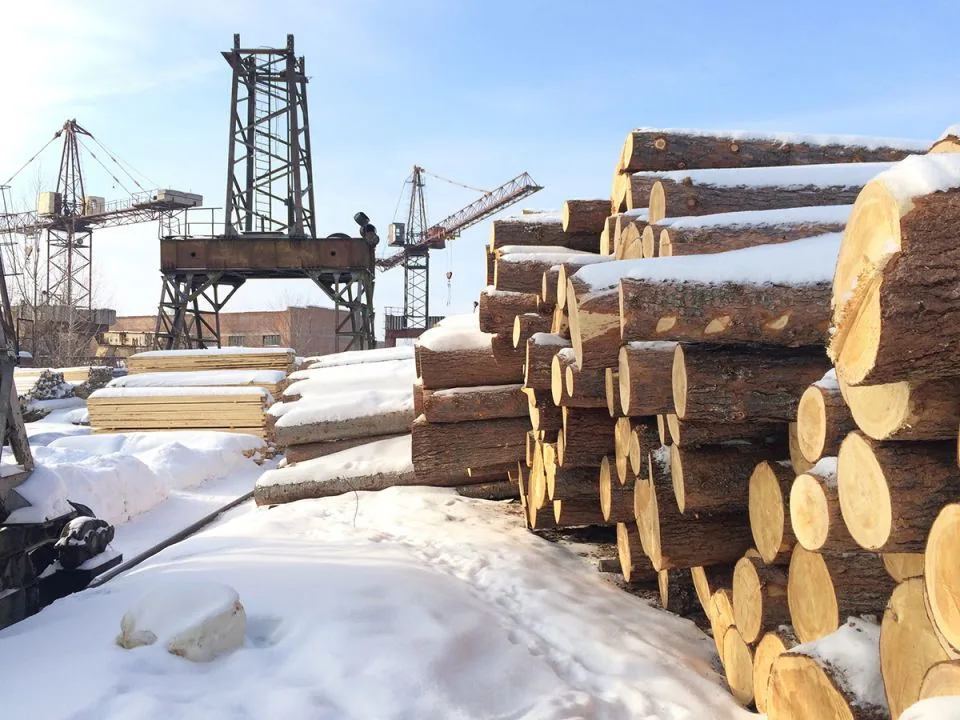
We follow a traditional felling method revived by the Austrian forester Erwin Thoma. We fell in winter, while the trees are dormant and the moon is waning, when the wood is denser and holds less sap. The felled trunks are left for several weeks with their crowns pointing downhill so that as much water as possible drains out.
- Lasting resistance to wood-boring insects and rot, even years on.
- A structure that holds its shape far better.
- We strip the bark with a high-pressure water jet: it’s three times faster, doesn’t damage the log and leaves a smooth surface that keeps its natural texture.
Timber protection and insulation
We use natural materials that let the timber breathe and keep your home healthy.
Natural oils and waxes
The first line of protection is Bochemit boron salt, followed by Kreidezeit base oil made from boiled linseed oil and balsam turpentine, and finally a top-coat oil with burnt earth and mineral pigments to block UV. The top coat is renewed after 7 years.
Sheep’s wool insulation
Between the logs and in the partitions we use Isolena insulation made from treated sheep’s wool. It insulates against heat loss and noise, is hypoallergenic, balances humidity and is the least flammable of all organic insulation materials. Its moth-proofing doesn’t wash out.
Certified timber
We hold PEFC and FSC certification, confirming that our timber comes from sustainably managed forests. Every building material we use is certified for quality and health safety.
Let’s build
yours next
We’ll get back to you within 48 hours.